AI shopping agents in ChatGPT, Microsoft Copilot and Google AI Mode already read your Shopify products through Shopify Catalog and send buyers to your store, and Adobe expects AI traffic to US retail sites to rise 130 percent this holiday season. What changes for you is that your product data, policies and stock accuracy now decide whether an agent recommends you, so the work before Black Friday is cleanup in your admin, not a new app.
I run TechnoPulse, a Shopify and Klaviyo Partner agency, and we have helped 200+ DTC brands since 2021. This post is what I am telling our clients this month: what is actually live, what an agent reads on your product page, a seven day checklist to finish before Black Friday on 27 November 2026, and how to measure the traffic without fooling yourself.
What the numbers say for this holiday
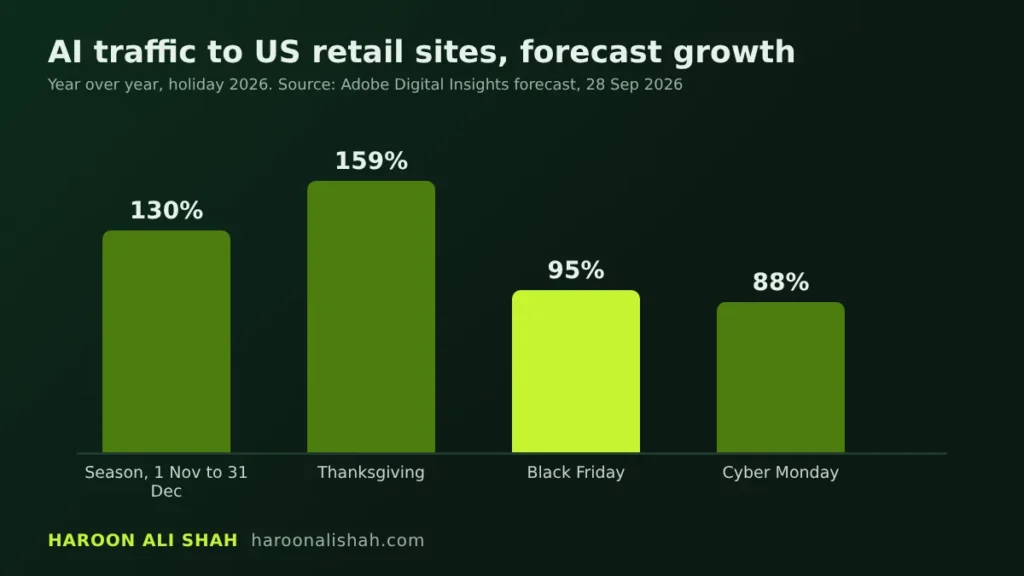
Adobe’s 2026 US holiday forecast, published 28 September 2026, expects US online sales of $275.1 billion for 1 November to 31 December, up 6.7 percent year over year. On AI traffic (shoppers clicking a link from an AI service to a retail site), Adobe forecasts:
- Whole season: up 130 percent year over year
- Thanksgiving: up 159 percent
- Black Friday: up 95 percent
- Cyber Monday: up 88 percent
Shopify’s own data points the same way. In its June 2026 explainer, Shopify says that in Q1 2026 AI driven traffic to Shopify stores grew 8 times year over year and orders from AI powered searches grew nearly 13 times. Keep the base in mind though. Growth rates this large usually start from a small number. For most stores we audit, AI referrals are still a thin slice of sessions. The reason to act now is not volume. It is that these shoppers arrive with a short list already made, and you either made the list or you did not.
What Shopify has actually shipped
There is a lot of noise on this topic, so here is only what Shopify’s official pages confirm.
- Agentic Storefronts (announced 10 December 2025, Winter ’26 Edition). A sales channel that connects your products to AI platforms. In your admin it lives under Sales channels > Agentic. The default setting, “Allow Shopify to manage for me”, keeps channels active and enrolls you in new ones automatically.
- Shopify Catalog. Structures your product data and syndicates it to AI channels. Eligible products are listed by default.
- ChatGPT (live since March 2026). Shopify announced on 24 March 2026 that millions of merchants can sell to ChatGPT users. The buyer finishes the purchase on your own store through an in app browser. OpenAI confirmed the same day that it is focusing on discovery and letting merchants use their own checkout, and that Shopify merchants need no extra work to be included.
- Microsoft Copilot is live, with Copilot Checkout for eligible merchants. Google AI Mode and Gemini are rolling out, powered by the Universal Commerce Protocol, an open standard Shopify built with Google.
- Fall ’26 Edition (28 October 2026). Shopify’s Fall ’26 Edition added a Catalog eligibility view in the admin, a knowledge base under Sales channels > Agentic where you review and publish the facts agents get about your store (return windows, shipping destinations, gift services), and wider Shop Promise eligibility. Shopify says badged products can rank higher in the Catalog data shopping agents use.
One limit matters for our clients in Europe and Australia: Shopify says purchasing across these AI channels is currently limited to US buyers.
What an AI agent reads on your product page
An agent is not charmed by your hero video. It reads fields, compares them across stores and picks the products it can describe with confidence. Shopify’s help center lists the inputs behind its “Listing quality” signal for agentic channels: descriptions, images, reviews, variants and options, and shop policies. OpenAI’s merchant page says richer data such as images, pricing and reviews helps products surface with more accurate information. Here is how I translate that into a page.
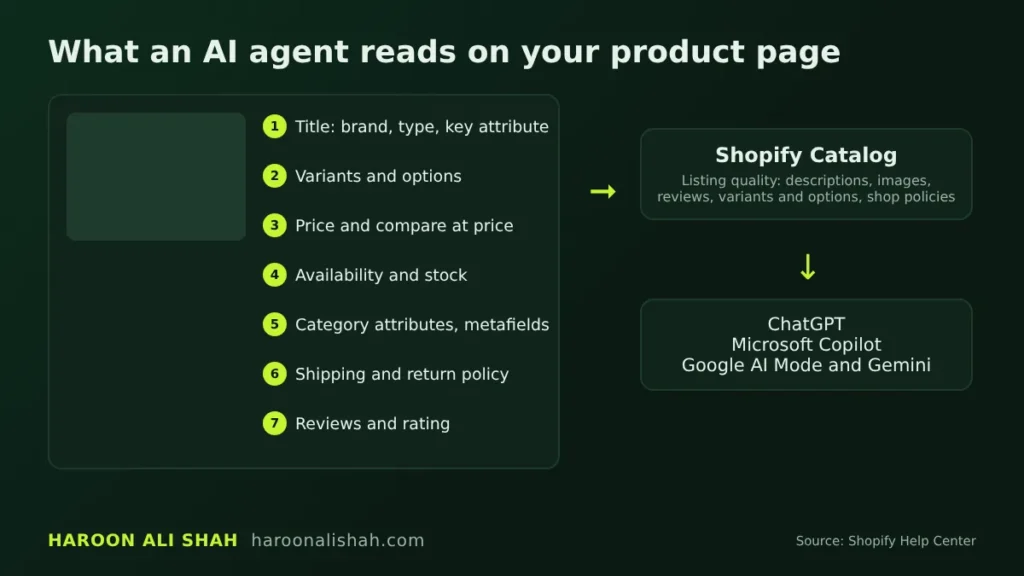
Product titles
Write what the thing is: brand, product type, key attribute. “Trail Tent, 2 Person, 3 Season, 1.8 kg” beats “The Wanderer”. Agents match shopper questions like “lightweight two person tent under 2 kg” against plain facts.
Variants and attributes
Every size, colour and material should be a real variant with its own price, SKU and stock, not a line of text in the description. Shopify’s Winter ’26 guidance is to group products by standard attributes and metafields. Set the Shopify product category on every product so the category attributes become available, then fill them.
Price and availability
Agents use live price and stock. If a variant shows in stock but cannot ship, the agent sends a buyer to a dead end and you lose that order plus the trust. Put Black Friday discounts on the product price (with a compare at price) where you can, because a code typed at checkout is invisible to an agent comparing prices.
Shipping and return policy
Write delivery times, free shipping thresholds, return windows and who pays return shipping in plain sentences, then publish them in the new knowledge base. For Google, mark them up in your theme’s structured data using the schema.org MerchantReturnPolicy type (return days, policy category, return fees) on your Product offers.
Reviews
Reviews feed the listing quality signal on Shopify and the product view in ChatGPT. Make sure your reviews app outputs them on the product page and in structured data, not only inside a widget that loads late.
A seven day checklist before Black Friday
Do this the week of 16 November at the latest, so you are done before your code freeze. If you want the wider list, our Shopify Black Friday checklist covers speed, checkout and email.
- Day 1, switch it on and check eligibility. Open Sales channels > Agentic. Confirm the channels you want are active and use the new Catalog eligibility view to fix anything blocking you.
- Day 2, publish your knowledge base. Shopify drafts facts from your storefront. Read every line, correct holiday shipping cutoffs and extended return windows, then publish. Agents only get facts you publish.
- Day 3, fix titles on your top 20 sellers. Take them from your sales report, rewrite titles and the first paragraph of each description as facts.
- Day 4, variants, category and metafields. Split text options into real variants, set product categories, fill size, material, dimensions and use case attributes.
- Day 5, policies and structured data. Rewrite shipping and returns pages in plain words, check that product pages output Product, Offer, review and return policy markup, and test a few pages in Google’s Rich Results Test.
- Day 6, price and stock truth. Load Black Friday prices as product prices where possible, check inventory sync, and hide anything you cannot fulfil using the Unlisted status or the seo.hidden metafield.
- Day 7, set your baseline. Record last 30 days of AI referral sessions, orders and conversion so you can compare after the weekend.
How to measure AI referral traffic in Shopify and GA4
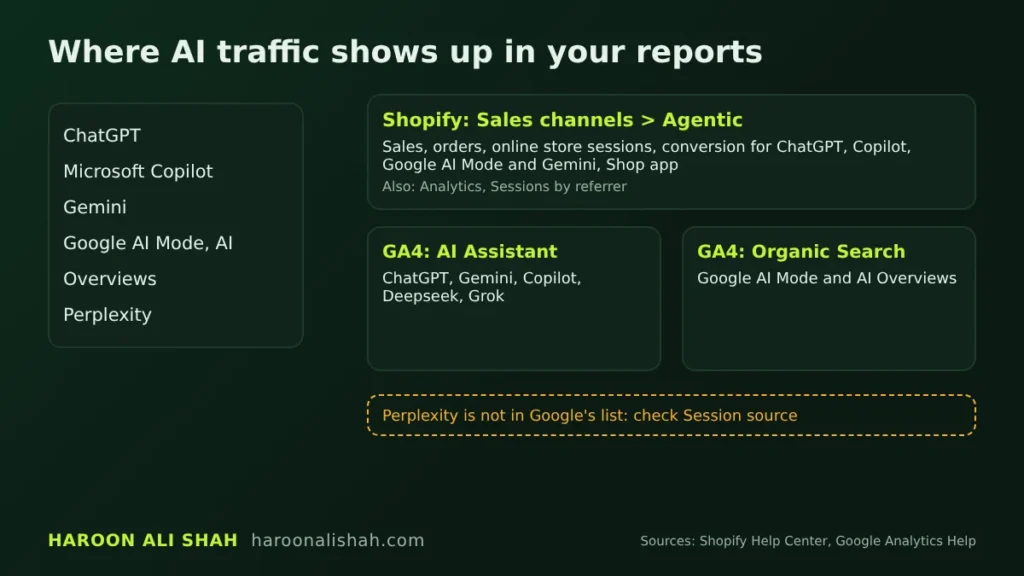
In Shopify
Sales channels > Agentic shows per channel reports for sales, orders, online store sessions and online store conversion. Shopify notes sales there combine referral based sales and direct checkout sales, and that these analytics are not yet available for headless stores. For a second view, open the Sessions by referrer report in Analytics and filter by referring channel for the assistant domains you care about, such as chatgpt.com, copilot.microsoft.com, gemini.google.com and perplexity.ai.
In GA4
Google Analytics now has an AI Assistant default channel for visits from sources like ChatGPT, Gemini, Deepseek, Copilot or Grok. Two traps: Google lists AI Overviews and AI Mode under Organic Search, not AI Assistant, and Perplexity is not named in Google’s list. Build a simple exploration on session source so nothing falls through the gap.
Read it honestly
AI referrals are small and spiky. Do not redesign your product page off one weekend of data. Our guide on how long to run an A/B test explains why small samples lie.
What not to do
- Do not buy an “AI ranking” app. Shopify Catalog already syndicates your data. No vendor can promise placement in ChatGPT or Gemini.
- Do not block OpenAI’s search crawler in robots.txt if you want to appear in ChatGPT search. OpenAI says sites that opt out of it will not appear in ChatGPT search answers.
- Do not stuff keywords into titles. Agents compare facts. A title full of “best gift sale 2026” tells them nothing.
- Do not neglect the page the agent sends people to. The buyer still lands on your store to pay. A slow page or a confusing variant picker loses the order the agent won for you.
- Do not let AI pull budget from retention. A physician led supplement brand we work with gets 85 percent of its orders from returning customers. An agent gets the first order. Your Klaviyo flows get the next ten.
My view
I think agentic commerce is real, and I think most of the advice about it is too complicated. For a Shopify brand, the work is the same work that has always lifted conversion: clear titles, honest variants, accurate stock, plain policies and real reviews. Agents simply punish sloppy data faster than humans did. Our best client numbers, like an outdoor camping gear brand that grew online sales 5.8x and lifted conversion 49 percent, are conversion numbers, and conversion is won on the product page. That is what our CRO services focus on, and it is what I would do this week if I owned your store.
If you are not sure where your store stands, start with the six questions I ask in every Shopify store audit.
Not sure which of these is costing your store the most? Get your free store score or book a free 15 minute audit call.
FAQ
Do I need an app to sell through ChatGPT on Shopify?
No. Shopify and OpenAI both say Shopify merchants are covered through Shopify Catalog and Agentic Storefronts, with no extra integration. Check Sales channels > Agentic to confirm your store is eligible and the channel is active.
How do I see ChatGPT traffic in GA4?
Look at the AI Assistant default channel, which covers sources like ChatGPT, Gemini, Copilot, Deepseek and Grok. Google AI Mode traffic sits in Organic Search, and Perplexity is not in Google’s list, so also check session source.
Can I stop AI agents from showing some products?
Yes. Shopify lets you hide products from all agentic storefronts with the Unlisted status or the seo.hidden metafield, and you can turn off “Allow Shopify to manage for me” to control Catalog access per channel.
Can shoppers in Europe or Australia buy through AI agents?
Not yet through Shopify’s AI channels. Shopify says purchasing is currently limited to US buyers. Google says its new checkout features roll out in the US first, with Australia and Canada to follow early next year.
Get your store ready before Black Friday
Want a second pair of eyes on your product data, policies and tracking before 27 November? We are rated 5.0 on Google from 40+ client reviews. Book a free Shopify store audit and we will show you what agents see on your store and what to fix first.
Keep reading:
Want this done on your store?
Book a free audit call