To set a free shipping threshold on Shopify that makes money, start from your median order value, add the extra spend needed to pay for the shipping you are giving away (your full shipping cost divided by your gross margin), and round up to a clean number. Most Shopify stores I audit skip that math and copy a round number like $50 from a competitor, which quietly hands free shipping to customers who were going to buy anyway.
I have worked with Shopify brands since 2021, and across more than 200 DTC brands the free shipping line in the cart is one of the most common places DTC founders leak margin without knowing it. Nobody notices, because conversion rate went up. Here is the mistake and the test I use to fix it.
Why free shipping is a pricing decision, not a perk
Shipping cost matters to shoppers. In Baymard Institute’s checkout research, extra costs like shipping, tax and fees are the top reason US shoppers give for abandoning a checkout once you set aside people who were just browsing, named by 40 percent of them. Shopify’s own enterprise team, citing Shippo’s 2023 State of Shipping report, notes that nearly half of consumers will add items to their cart to qualify for free shipping.
So the threshold works, which is exactly why it is dangerous. It is a price you set on shipping. Too low and you pay shipping on orders that never needed the nudge. Too high and nobody reaches it. The goal is a number that changes behavior, not one that rewards behavior you already had.
The five threshold mistakes I see most
1. Copying a competitor’s round number
“Free shipping over $50” shows up on store after store in every niche. Their order sizes, box sizes and margins are not yours. A number that is healthy for a brand selling $80 jackets can be a giveaway for a brand selling $30 refills.
2. Using average order value instead of the median
Average order value gets pulled up by a handful of big orders. If your average is $61 but your median is $52, a threshold set “just under AOV” is already cleared by more than half your orders without anyone changing a thing. Always look at the median and the spread, not the average alone.
3. Counting only the label
The postage label is not your shipping cost. Add the box, the void fill, the 3PL pick and pack fee for that order, and any surcharge for zones you ship to often. On most stores I look at, the real number is noticeably higher than the label figure the founder has in their head.
4. Letting discount codes stack under the threshold
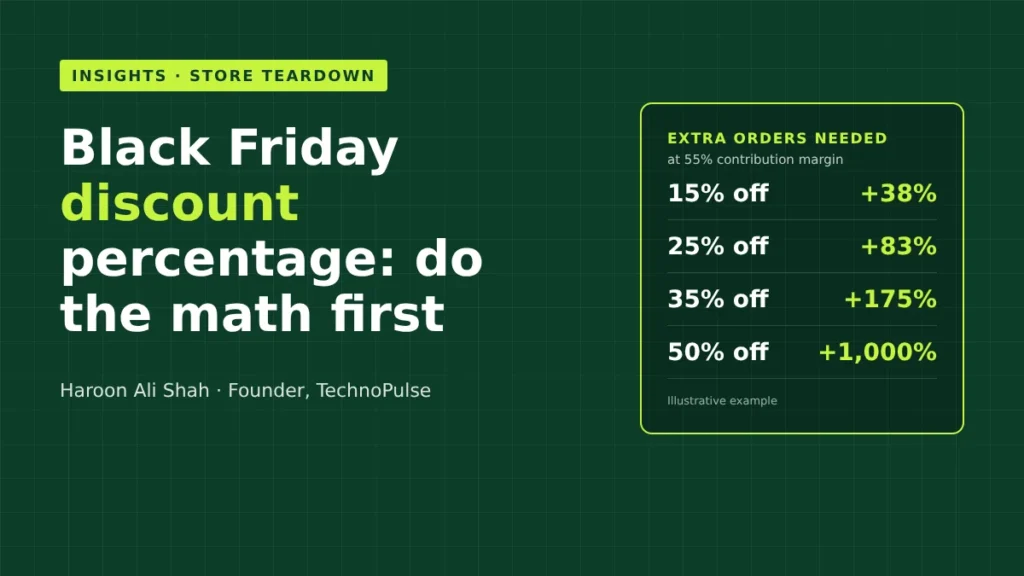
A shopper with a welcome code builds a $60 cart, applies 15 percent off, and still gets free shipping if your rate is checked before the discount. Now you have given away the discount and the shipping on the same order. Before any sale, check the Black Friday discount percentage math as well. Put a discounted test cart through your own checkout and see which subtotal your free rate actually reads. Then decide on purpose.
5. Never revisiting it
Prices go up, carriers raise rates, bundles change order sizes. A threshold set two years ago is usually wrong today.
How to set a free shipping threshold: my three number test
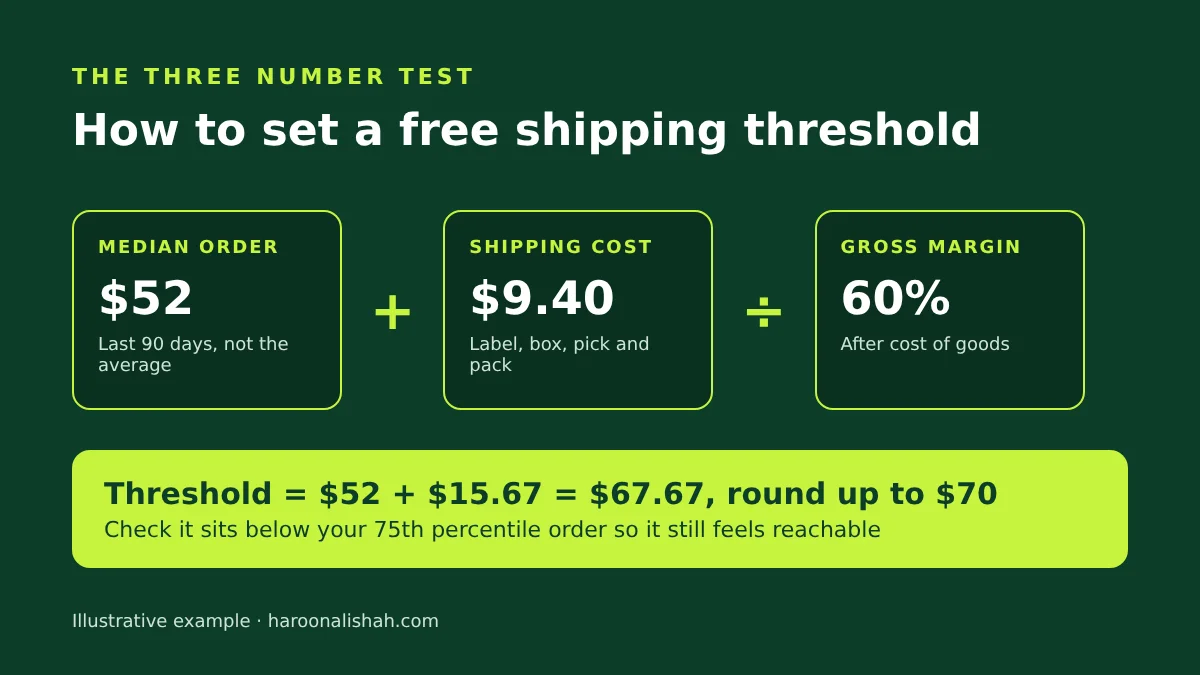
This is the model I use on audits. You need three numbers from the last 90 days of orders.
- Median order value. Export orders from Shopify and sort by subtotal. Note the median and the 75th percentile.
- Landed shipping cost per order. Label, packaging, pick and pack, surcharges. Use the average across real orders.
- Gross margin. After cost of goods, not after ads.
Then the rule is simple: threshold = median order value + (landed shipping cost ÷ gross margin), rounded up to a clean number. The second part is the extra product a shopper must add for the margin on that product to cover the shipping you are now paying.
If the result lands above your 75th percentile, the threshold will feel out of reach. In that case a flat low shipping rate usually beats free shipping, and it is worth testing that instead.
A worked example
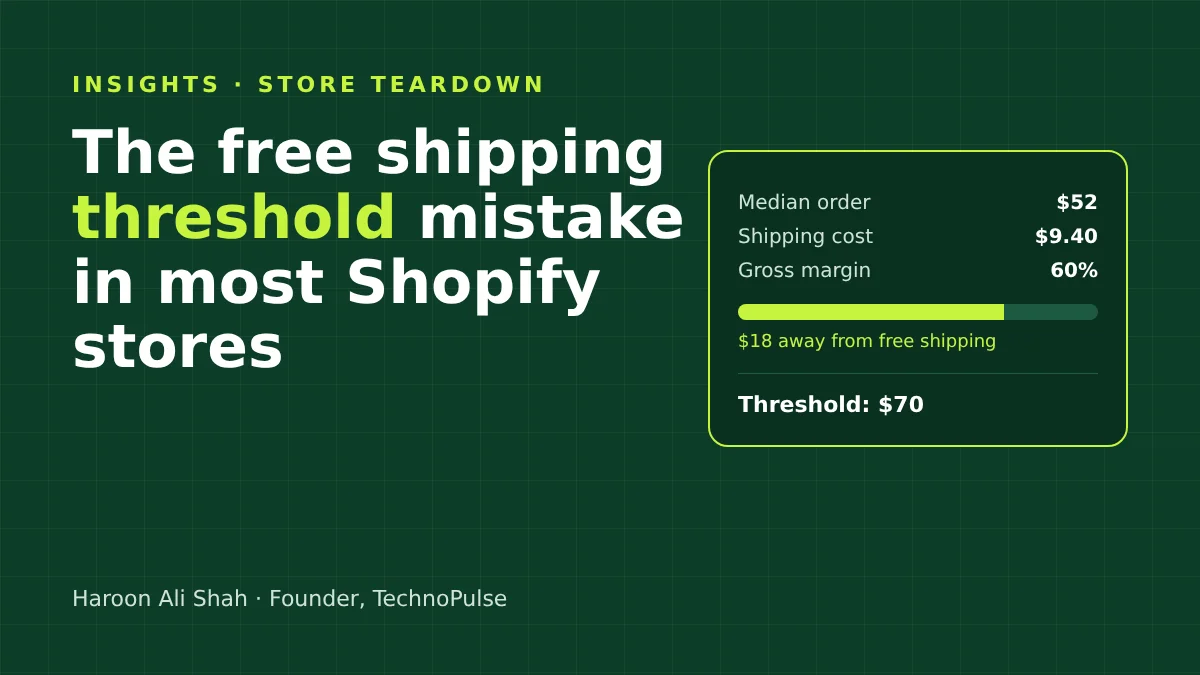
To show how to set a free shipping threshold with real math, here are illustrative numbers close to what I often see on a mid sized apparel store. Median order $52, average order $61, 75th percentile $78. Landed shipping $9.40 per order. Gross margin 60 percent. The current threshold is $50.
- Lift needed: $9.40 ÷ 0.60 = $15.67 of added product.
- New threshold: $52 + $15.67 = $67.67, rounded up to $70.
- $70 sits between the median and the 75th percentile, so it is a stretch, not a wall.
Now the cost of the old setting. At $50, more than half the orders already qualified. If the store does 2,000 orders a month and 55 percent clear $50 on their own, that is 1,100 orders × $9.40 = $10,340 a month in shipping paid on orders that did not need a reason to buy. It never shows up as a loss, just as a thinner month.
How I roll out a new threshold
- Show the gap, not the rule. A cart message that says “You are $14 away from free shipping” with one add on product next to it does the work. A banner that only states the rule does much less.
- Give them something to add. Pick low cost, high margin items that close the typical gap. If nothing in your catalog fits the gap, build a small bundle that does.
- Set it per market. Shipping to Canada or the EU costs differently. Run the same three number test for your top markets.
- Judge it on gross profit per order. Watch conversion rate, median order value and the share of orders above the line, but make the call on profit per order over at least four weeks.
- Tell your list. A change like this belongs in your flows too. I covered how I structure those in my post on Klaviyo retention flows.
The threshold is one of the first things I check in an audit, alongside the questions in the six questions I ask before I touch a Shopify store. It is a small setting with a direct line to margin, which is why it often pays for the rest of the CRO work. If you want a team to run this kind of test end to end, that is what we do in our CRO services at TechnoPulse.
Not sure which of these is costing your store the most? Get your free store score or book a free 15 minute audit call.
Free shipping threshold FAQ
What is a good free shipping threshold for a Shopify store?
There is no universal number, so set a free shipping threshold from your own order data. A good threshold sits above your median order value by enough to pay for the shipping, and below your 75th percentile so it still feels reachable.
Should my free shipping threshold be higher than my AOV?
Usually yes, because a threshold at or below your typical order rewards orders you already get. Compare it to the median rather than the average, since the average is skewed by a few large orders.
Does a free shipping threshold increase conversion rate?
It can, because extra costs are the top reason shoppers give for abandoning a checkout. But conversion rate alone is the wrong scorecard. A lower threshold almost always lifts conversion and can still lower profit. Measure gross profit per order.
Is free shipping on every order better than a threshold?
Only if your prices already carry the shipping cost and your margins can take it on your smallest orders. For most stores with a wide range of order sizes, a threshold or a flat low rate protects margin better.
How often should I change my free shipping threshold?
Recheck it whenever prices, carrier rates or bundles change, and at least twice a year. If you want me to look at yours, get in touch or see the results we have delivered for other brands.
Keep reading:
Want this done on your store?
Book a free audit call