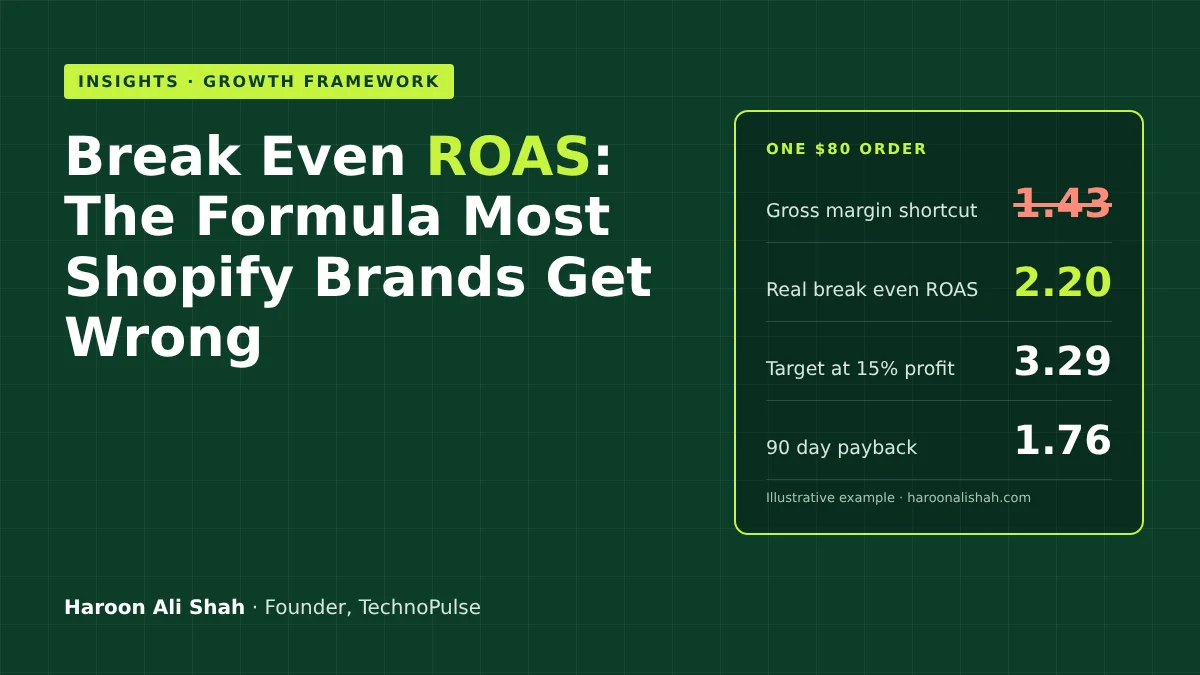
Your break even ROAS is your order value divided by the contribution you keep from that order after every variable cost, not just product cost. Most Shopify brands I audit calculate it from gross margin alone, so they think they are profitable at a ROAS that is quietly losing money on every sale.
I have worked with Shopify brands since 2021, first as a Top Rated freelancer on Upwork and now through TechnoPulse, and across 200+ DTC brands the same pattern keeps showing up. The founder knows the product margin to the cent. Nobody has put shipping, payment fees, discounts and returns into the same number that decides how much they can pay Meta for a sale. This guide fixes that with one framework, a fully worked example and the target numbers I actually hand to media buyers.
What breaking even on ads actually means
ROAS is revenue from ads divided by ad spend. A ROAS of 3 means $3 of revenue for every $1 you spent. Your break even point is the ROAS at which the contribution from those orders exactly pays for the ads. Below it you lose money on each ad driven order. Above it you make money before fixed costs like salaries, rent and apps.
The textbook formula is simple:
- Break even ROAS = 1 ÷ contribution margin
- Contribution margin = (order revenue minus variable costs) ÷ order revenue
Shopify’s own guide uses this same structure and lists product cost, shipping, payment processing and pick and pack as the costs to subtract. That part is right. The problem is what happens in practice, and what most calculators leave out.
Why most break even numbers are wrong
I read the top ranking calculators before writing this. Almost all of them are built by ad tools, and they share the same blind spots. Here is what I see go wrong inside real stores.
1. Using gross margin instead of contribution
A founder says “our margin is 70 percent” and divides 1 by 0.70 to get a break even of 1.43. That 70 percent is product margin only. Shipping, packaging, fulfillment and card fees all come out of the same order. Together they can take a big share of every order, and none of it shows up in the product margin.
2. Ignoring returns completely
None of the popular calculators I checked put returns into the formula. That is a big miss. The National Retail Federation and Happy Returns estimated that 19.3 percent of online sales would be returned in 2025. That is an all retail estimate, so your category could be far lower (consumables) or higher (apparel), but your ads platform counts every one of those returned orders as revenue.
3. Using list price instead of what customers paid
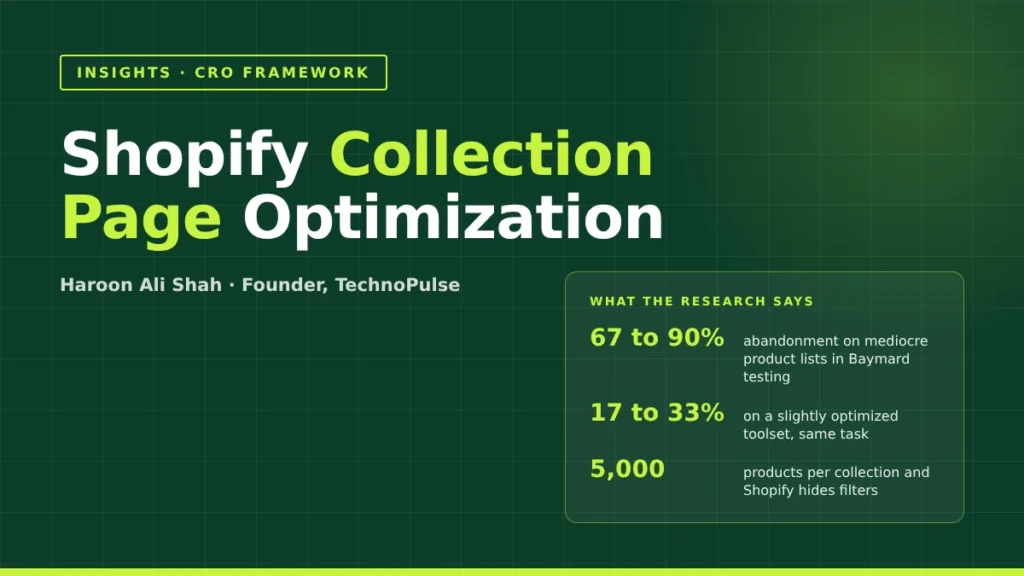
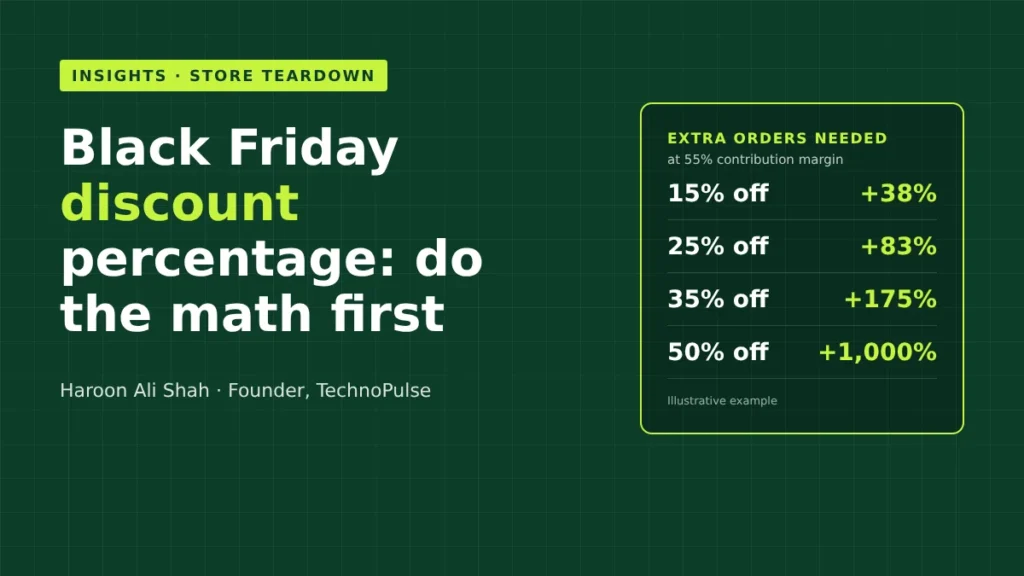
If your average order value assumes full price but half your orders use a 15 percent welcome code, your margin is lower than your spreadsheet says. Planning a sale? I run the same contribution math in how to pick a Black Friday discount percentage. Always pull real average order value from Shopify, after discounts, for the same period you are measuring ads.
4. Stopping at the first order
First order break even is the right floor for a brand with weak retention. For a brand where customers come back, it makes you too conservative and you lose the auction to competitors who know their repeat value. I cover how to handle that further down.
How to calculate break even ROAS: a worked example
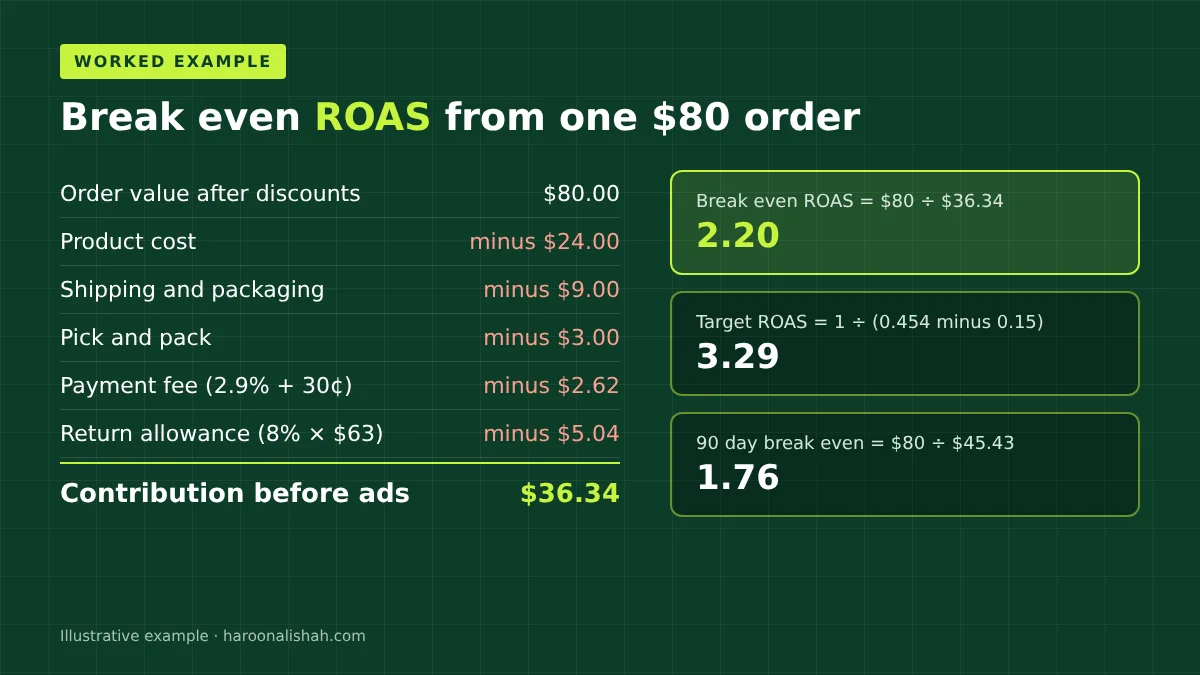
Here is the exact model I build in an audit. The numbers below are an illustrative example of a typical DTC order, not a client’s data. Swap in your own.
- Average order value, after discounts: $80.00
- Product cost (COGS): $24.00
- Shipping and packaging: $9.00
- Pick and pack: $3.00
- Payment fee: $2.62 (2.9 percent plus 30 cents, the standard online card rate in USD on the Basic plan, per Shopify’s pricing page)
- Return allowance: $5.04 (explained below)
Step 1: Build the return allowance
Assume 8 percent of orders come back. On each return you refund $80, you get the product back and can resell it (so you recover the $24 product cost), and you pay about $7 for the return label. The loss per return is $80 minus $24 plus $7, which is $63. Spread across all orders, that is 8 percent of $63, or $5.04 per order. If returned items cannot be resold, do not subtract the product cost and the allowance gets much bigger.
Step 2: Find contribution per order
$80.00 minus $24.00 minus $9.00 minus $3.00 minus $2.62 minus $5.04 leaves $36.34 of contribution before ads. That is a contribution margin of 45.4 percent.
Step 3: Divide
$80 ÷ $36.34 gives a break even of 2.20. The gross margin shortcut would have said 1.43. Every campaign running between 1.43 and 2.20 looks profitable in the founder’s head and loses money in the bank account. In this example, that gap is where most of the wasted budget hides.
The same number tells you your break even cost per purchase. With $36.34 of contribution, you can pay up to $36.34 in ad spend for each order and still not lose money on it. Media buyers often find a cost per purchase target easier to manage day to day than a ROAS target, and they are two views of the same math.
From break even to a target ROAS
Break even is the floor, not the goal. You still have fixed costs to cover and you want profit. So I set a target contribution after ads, as a share of revenue, and build the target from it:
- Target ROAS = 1 ÷ (contribution margin minus target profit margin)
If you want 15 percent of revenue left after ads, the example becomes 1 ÷ (0.454 minus 0.15), which is a target ROAS of 3.29. That is why a 3 ROAS can be great for one brand and a slow bleed for another. The number only means something next to your own margin.
I give clients three lines, not one:
- Kill line: below break even for 7 days with enough purchases to trust it. Pause or rebuild.
- Hold line: between break even and target. Keep spend flat and work on creative, offer and landing page.
- Scale line: above target. Raise budget in steps and watch whether ROAS holds.
When a first order break even is too strict
If your customers reorder, the first order is not the whole value of the customer you just paid for. At a physician led supplement brand we work with, 85 percent of orders come from returning customers. Judging that brand’s acquisition on first order ROAS alone would starve its best channel.
The fix is a payback window. Pick a period you can fund from cash, usually 60 to 90 days, and measure the contribution a new customer brings in that window. Using the example again, assume 25 percent of new customers buy once more within 90 days at the same order value. Expected contribution per new customer is $36.34 plus 25 percent of $36.34, or $45.43. The 90 day break even on the first order drops to $80 ÷ $45.43, which is 1.76.
Two rules keep this honest. Use your measured repeat rate from Shopify cohorts, never a hoped for one. And only use the window your bank balance can wait for. If you want the full method for measuring repeat value, my guide to Shopify customer lifetime value walks through it step by step.
Platform ROAS versus blended ROAS
Your break even number is only useful if the ROAS you compare it with is real. Ad platforms report the revenue they claim credit for, which can include view through conversions and orders another channel also claims. Add the platforms together and you often get more revenue than Shopify recorded.
So I check two numbers every week. Platform ROAS for decisions inside one account, like which ad set to cut. Blended ROAS (total Shopify revenue ÷ total ad spend across every channel) for the business decision of whether ads are paying for themselves. If blended ROAS sits below your break even while each platform claims it is above, believe the blended number.
Four ways to lower your break even point
Most founders try to fix a bad break even by pushing the ad account harder. The faster win is usually changing the order itself, because every point of contribution margin you add lowers the ROAS you need.
- Raise order value. Bundles and a sensible free shipping threshold spread shipping and fees over a bigger basket.
- Convert more of the traffic you already pay for. A better product page and checkout lower your cost per purchase without touching ad spend. This is the core of our CRO work at TechnoPulse.
- Cut returns at the source. Clear sizing, real photos and honest copy reduce the return allowance directly.
- Stop discounting by default. A permanent sitewide code is a permanent cut to your contribution margin.
When the order economics are fixed, the ad account has room to scale. That is the order I work in, and it is how our Meta ads team sets targets before any budget moves.
Not sure which of these is costing your store the most? Get your free store score or book a free 15 minute audit call.
Break even ROAS FAQ
How do I calculate break even ROAS?
Take your average order value after discounts and subtract product cost, shipping, packaging, fulfillment, payment fees and a return allowance. Divide what is left by the order value to get contribution margin. Then divide 1 by that margin. A 40 percent contribution margin gives a break even of 2.5.
What is a good break even ROAS?
Lower is better, because a low break even means high margins and more room to bid. There is no universal good number since it comes straight from your own costs. What matters is the gap between your break even and the ROAS your ads actually deliver on a blended basis.
Is a 2.5 ROAS good?
It depends on your margin. In the example above, 2.5 clears the 2.20 break even but falls short of the 3.29 target, so it is in the hold zone. For a brand with a 30 percent contribution margin, the break even is 3.33, so a 2.5 ROAS loses money on every order.
If you want me to build this model on your real Shopify numbers and check whether your ads clear it, get in touch here. You can also see the kind of results this thinking leads to on my work page.
Keep reading:
Want this done on your store?
Book a free audit call