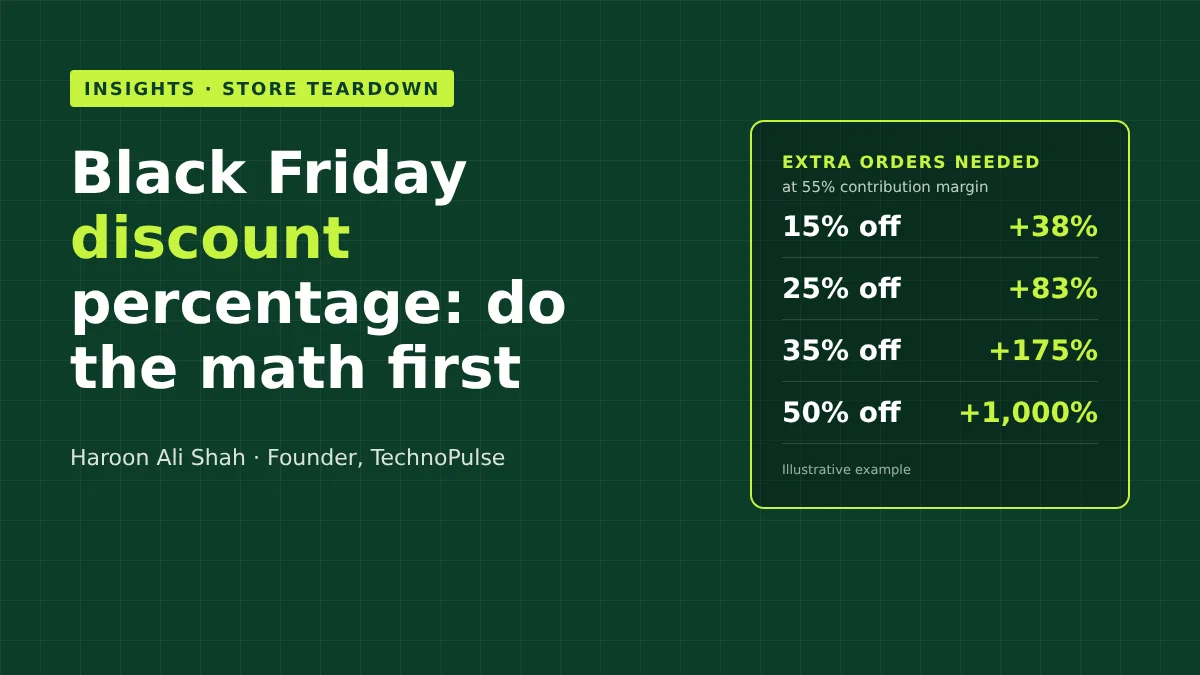
The right Black Friday discount percentage is the one your contribution margin can pay for, and you can work it out in five minutes before you pick a number. Most Shopify stores do it the other way round: they copy the 30 percent banner a rival is running, then hope volume covers the gap.
I have worked with Shopify brands since 2021, first as a Top Rated freelancer on Upwork and now through TechnoPulse, and I have helped 200+ DTC brands since then. Every November I see the same mistake. The discount gets chosen in a team chat. Nobody checks how many extra orders it needs to break even. So this is my teardown of that mistake, with the math I use instead.
Why copying a big number is the expensive mistake
Shoppers do expect deep cuts. Adobe Analytics reported that during the 2025 US holiday season, discounts peaked at 30.9 percent off listed price for electronics and 25.1 percent for apparel. Those are peaks across the season, not average discounts. Meanwhile a Morning Consult survey of 1,331 US adults in December 2024 put the ideal Black Friday and Cyber Monday discount between 31 and 51 percent off, with 35 percent as the optimal point.
Big retailers can run those numbers because they negotiate cost, ship at scale and sell accessories on top. A DTC brand with a 55 percent contribution margin cannot. However, the banner looks the same to a shopper, so founders feel pressure to match it. That is the trap.
The Black Friday discount percentage formula
Start with contribution margin per order at full price. That is price minus product cost, shipping and packing, payment fees and any per order app costs. Do not use gross margin alone. I explain why in my post on break even ROAS, and the same logic applies here.
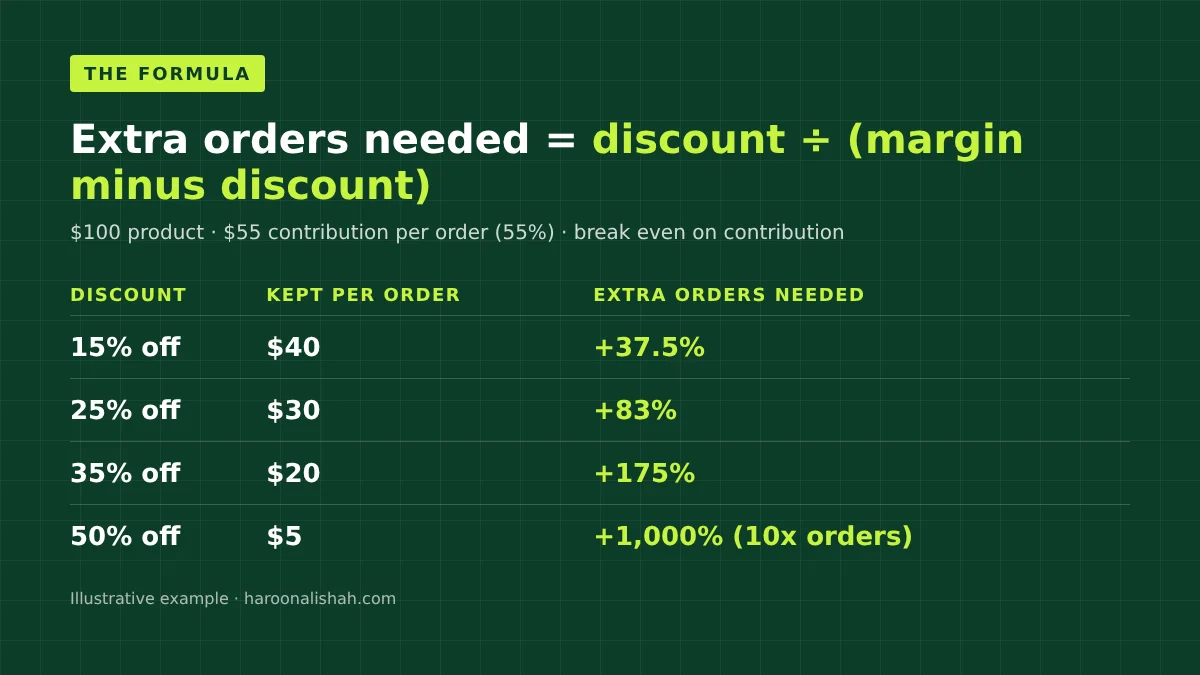
Then use this: extra orders needed = discount ÷ (contribution margin minus discount). Both numbers are percentages of the full price. The answer tells you how many more orders you need just to earn the same contribution you would have earned with no sale at all.
A worked example
Here is an illustrative example, not a client, so you can see how each Black Friday discount percentage changes the math. A product sells for $100. Product cost is $30, shipping and packing are $10, and fees are about $5. So contribution is $55 per order, or 55 percent.
- 15 percent off: you keep $40 per order. You need 0.15 ÷ 0.40, which is 37.5 percent more orders.
- 25 percent off: you keep $30. You need 0.25 ÷ 0.30, about 83 percent more orders.
- 35 percent off: you keep $20. You need 0.35 ÷ 0.20, which is 175 percent more orders.
- 50 percent off: you keep $5. You need 0.50 ÷ 0.05, which is ten times the orders, or 1,000 percent more.
Look at the jump between 25 and 35 percent. Ten more points of discount more than doubles the lift you need. Now add ads. If your Black Friday cost per purchase is $20, the 35 percent offer leaves exactly zero on every paid order. In other words, you are working the busiest week of the year for free.
How I set a Black Friday discount percentage instead
I do not start from what shoppers expect. I start from what each product can afford, and then I decide where to spend the margin. This is the order I use with brands.
- Find the ceiling. Your contribution margin minus your expected cost per paid order is the most you can give before every paid order loses money. Stay well under it.
- Set a realistic lift. Look at last year. If your sale drove 60 percent more orders, do not plan a discount that needs 175 percent.
- Split the catalog. Put the deepest cut on high margin or slow stock. Keep hero products at a smaller cut, or give a gift with purchase instead.
- Use spend tiers. Offers like $20 off $100 lift order value, so the discount works as a share of a bigger basket. The same logic sits behind a free shipping threshold.
- Protect returning buyers. Give your list early access or a bonus product rather than a deeper code. Returning buyers carry your margin, as I show in what a good repeat purchase rate looks like.
That last point matters more than most founders think. At a physician led supplement brand I work with, 85 percent of orders come from returning customers. A sitewide 30 percent code there would mostly pay people who were already going to reorder. Instead, a Klaviyo flow that gives subscribers first access usually does the job without the margin hit.
My honest opinion on Black Friday sales
A smaller discount that you can afford beats a big one you cannot. Yes, you will lose some bargain hunters who only click on 40 percent off. But those shoppers rarely come back at full price, so they were never your best customers anyway. Your customer lifetime value comes from the people who buy again.
The brands I have seen do well in Q4 treat Black Friday as a margin decision first and a marketing decision second. That is the same mindset behind our best results, like an outdoors brand that grew online sales 5.8x. If you want a second pair of eyes on your offer and your conversion rate before next week, our CRO team at TechnoPulse runs exactly this check, or you can get in touch with me directly.
Black Friday discount percentage FAQ
What is a good discount percentage for Black Friday?
A good discount is one your contribution margin can carry at a lift you can realistically reach. In the illustrative example above, 15 to 25 percent keeps the lift you need under double, so deeper cuts belong only on high margin or slow stock. Run the formula above with your own numbers before you commit.
Is 30 or 50 percent off better for Black Friday?
Only if your margin supports it. In the illustrative example, 50 percent off needs ten times the normal orders to break even. Most stores never see that, so 50 percent off usually works only for clearance stock.
How do I calculate how many more sales I need after a discount?
Divide the discount by your contribution margin minus the discount. With a 55 percent margin and 25 percent off, that is 0.25 ÷ 0.30, so you need about 83 percent more orders to stay level.
Should I discount my whole store on Black Friday?
Usually not. A tiered offer or a split catalog protects hero products and margin. Sitewide codes also reward returning customers who would have bought anyway.
Want this done on your store?
Book a free audit call